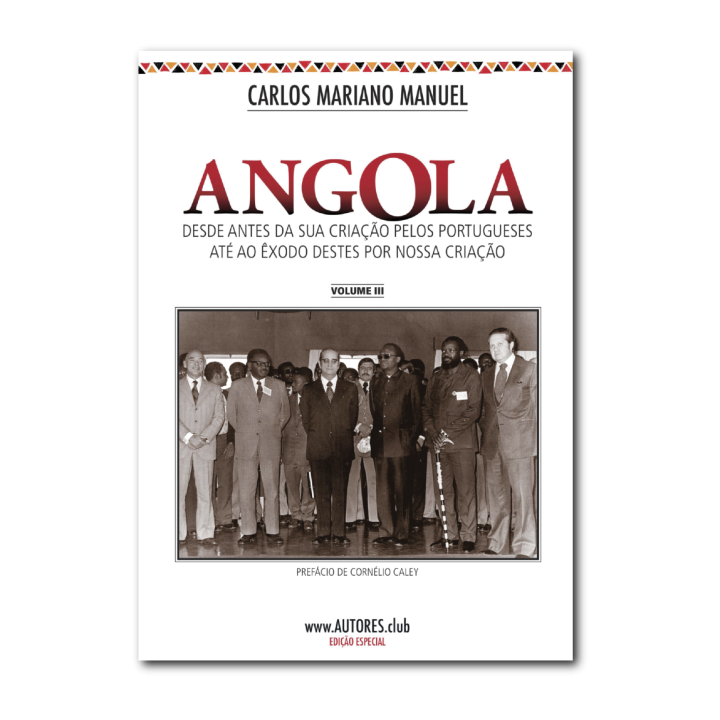
INDEX - VOLUME III
Preface III, by Cornelius Caley
CHAPTER XIX
The unfavorable international context after World War II to the maintenance of colonialisms
The effects of the Berlin Conference on Africa on the African diasporas
Increasing mobilization in the world against colonialism Portuguese
Collective mobilization of African nations and peoples against colonialism in general and against Portuguese in particular
Opposition of Portuguese progressive circles against colonialism practiced by the authorities of their country
CHAPTER XX
Association organizations of Angola, mostly claimative, and religious with liberation doctrine, that preceded the outbreak of uprisings and uprisings against colonialism
Angolan League
African Guild
Luanda Athletic Club
Gémio peace and work
Cultural Society of Angola
African National League
Anangola
South Angola African Association
Protestant churches were also a peaceful bastion for the extinction of colonialism
CHAPTER XXI
The joint historical events referred to as the "Process of 50"
On the nature and designation of the "Process"
The seemingly fortuitous incident that unpologetised the famous "Process of 50"
The second wave of repression against the nationalists involved in the "Process"
The evocation of the mobilizing heroism of King Muana Malaza or Nvita Nkanga or D. António I of congo, hero-martyr of the battle of Ammbuíla, by the Movement for the Independence of Angola (MIA)
CHAPTER XXII
The patriotic days that shook colonialism in Angola in the first quarter of 1961
Uprising and insurrection in Kassange Downtown
Obscurantist and sincreetic oath of the unrisen
Military actions of the natives and the Portuguese in The Lower Kassange
The events of February 4 (and subsequent) in Luanda
Superstition and obscurantism instrumentalized for the mobilization of those involved
15 March 1961: the hecatombe of the colonial regime
Succession of military actions of the unemerged and carried out only in the Uige
Assessment of events in Angola by the UN Security Council
Second UN Security Council meeting on the situation in Angola
CHAPTER XXIII
Angolan nationalism with initial regional expression: the case of UPNA, then with national expression of UPA and finally FNLA
General political, diplomatic and military dynamics in the context of the struggle for independence
The reasons for the multicentric and asynchronous origin of Angolan nationalist organizations
CHAPTER XXIV
The National Front for the Liberation of Angola (FNLA)
The initial political constraints of the FNLA, based on the alienation in 1885 of the southern region of the fragmented kingdom and Congo empire to Portugal by means negotiated with Belgium and France, its consequent aggregation to the primitive colony of Angola and creation of the district of congo Portuguese with capital in Cabinda
The relationship between the origin of Angolan nationalism and the competition between religious confessions established in northern Angola
Portuguese military expedition to Damba and submission of its native population
The role of the Baptist missionary society (with the initials in English BMS) in the ontology of Angolan nationalism in northern Angola
The relevance of the mission of Baptist Protestants in the ontology of nationalism in northern Angola
The tribulations in succession on the throne of the Congo in the first half of the 20th century and the origin of Angolan nationalism in northern Angola
Immediate background to the founding of UPNA
The stormy entry of the UPA-FNLA leader into Angola's history
Central African geopolitics and ethnonationalism in contrato the UPA's aspirations
The relationship between the riots that occurred in 1960 in the former Congo Leopoldville and the outbreak of insurrections in Angola in 1961
Still the apocalyptic and insurrectional eruption in Northern Angola
From the formation of the National Front for the Liberation of Angola (FNLA) to the constitution of the Revolutionary Government of Angola in Exile (GRAE)
The dark and usual side of politics: ambition for power, intrigue and notable dissenities within the FNLA and GRAE
The fnla riot in Luvaka in 1966
The multiple punitive firing scans of rebel military personnel at the Kinkuzu military base in 1972
The profound and negative internal consequences recorded within the FNLA and consequent to the serious incidents at the Kinkuzu military base in 1972
Expansion of the guerrilla struggle under fnla/grae
Social assistance provided by GRAE
Other incidences of grae's diplomatic activity
FNLA's ideological identity
CHAPTER XXV
Angolan nationalism gathered within the Popular Movement for the Liberation of Angola (MPLA)
On the genesis of the designation of the political organisation
The training abroad of unifying political platforms of independent organizations of the territories under colonization of Portugal
The first serious and historic split within the MPLA
The formation of the Democratic Front for the Liberation of Angola (FDLA) and consequent self-resignation of the first (or second, depending on the perspective still of controversy) president of the organization
The MPLA's diplomatic offensive against FNLA-GRAE due to its recognition in 1963 by the OAU's African Liberation Committee (Committee of 9)
The triumphant government by coup d'état and led by Massamba Debat in Congo Brazaville has turned the country into a safe territory for the functioning of African political organizations with a pro-socialist and pro-communist political orientation
The relevance of Cuba's involvement in Africa in the consolidation of the anti-colonial struggle in Angola under the MPLA
The colonial conflict has tragically knocked on the door of the governor-general in office in Angola
In Cuba there is a popular adage that says: el que no tiene de Congo tiene de carabali
First visit in 1966 of the leader of the MPLA, Dr. António Agostinho Neto, and the military leader of the organization, José Mendes de Carvalho, to the Socialist Republic of Cuba, was decisive for the relaunch of the struggle auspiciada by the MPLA
The colonial conflict was also fratricidal and proxy: the tragedy of the physical disappearance in congo Kinshasa of five women affiliated in the mpla and integrated in the Camy squadron, who sought to internalize in Angola
The extension of the guerrilla stifled by the MPLA to the Eastern region of the
About the manifestations of tribalism and racism within the organization
Tumultuous challenge of MPLA members integrated into their i and II regions structures against the organization's superior leadership in 1972
The unity and cooperation agreement concluded on 13 December 1972 between the National Liberation Front of Angola (FNLA) and the People's Liberation Movement of Angola (MPLA)
The MPLA torn with two internal dissenities and rebellions from 1973: the cases of the eastern uprising and that of the militants in active revolt
The inconclusive I MPLA congress held in 1974 in Lusaka/Zambia
CHAPTER XXVI
Angolan nationalism of origin in the Center and South of the country: From religious and regional associationto the Foundation of the National Union for the Total Independence of Angola (UNITA)
The resistance of the populations still manifests in the form of ephemeral efforts to opposed and combat colonialism
The emergence of UNITA and its three congresses held before the end of the colonial conflict
The obscure phase of the organization and unmillioned design of its leader
The coup d'état of 25 April 1974 in Portugal, its effects in Angola in general and within UNITA in particular
CHAPTER XXVII
The "Holy Trinity" of Liberation of Angola: the efforts of each of the three armed and independent organizations to consolidate in a hegemonic way in their regions of origin and with greater political support, with particular emphasis on urban areas
The MPLA moved forward in Luanda in 1974 with the creation of the ephemeral Committee for Political Action of Angola (CAPA)
The competition for political and military hegemony between the Liberation movements
The entry of violence into urban areas and the influx of foreign forces into Angola, before the proclamation of independence, reflecting the component of proxy conflict in the context of the world Cold War
The last moment lost to the promotion of an independence and a further harmonious evolution in Angola, between the three Liberation Movements
The Battle of Quifangondo
CHAPTER XXVIII
The protracted and severe dystocia of Angola's independence
The almost simultaneous realization of the battle of Quifangondo took place on the outskirts of Luanda, opposing the fnla and the mpla, as well as the staff of their respective foreign military coalitions, and the proclamation of independence in three cities of Angola
The leaders of the three National Liberation Movements
The exodus of the Portuguese by the creation of the Angolans





Comments (0)
Your review appreciation cannot be sent
Report comment
Report sent
Your report cannot be sent