

- On sale!
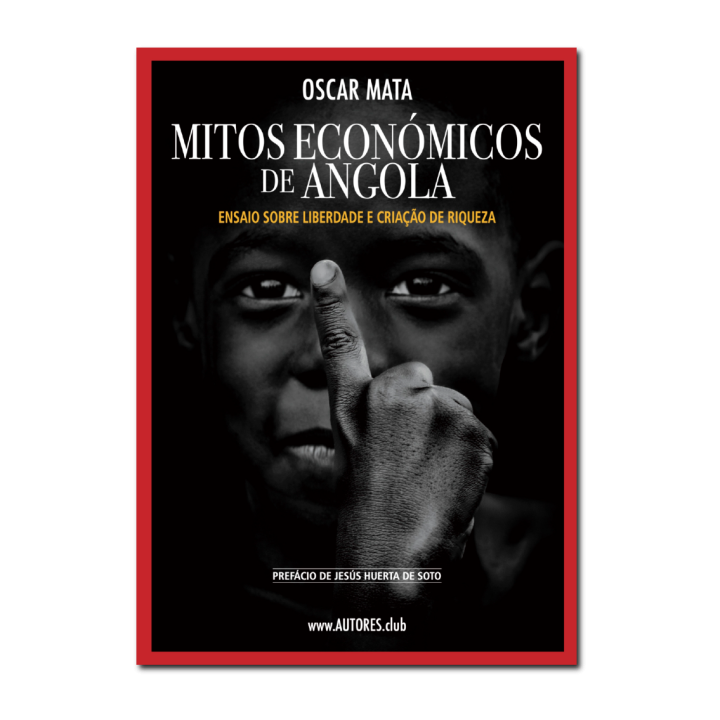
Angola’s Economic Myths — An Essay on Freedom and Wealth Creation images
Angola’s Economic Myths — An Essay on Freedom and Wealth Creation
Price:
€18.00
Tax included
Before wealth can be distributed, it must first be created
In this book, the author examines and dismantles eighteen widely held myths in Angola’s economic debate, revealing how many policies presented as technically inevitable are, in reality, driven by short-term political expediency. Inflation, price controls, public-sector banks, subsidies, debt, central planning and excessive taxation are examined in the light of economic theory, historical evidence and the African experience.
Author: Oscar Mata
Publisher: Perfil Criativo – Edições
First edition: September 2026
ISBN: 978-989-9209-43-5
Number of pages: 116
Language: Portuguese
Upon opening this book, readers will encounter a reflection on a decisive question: what factors influence countries when choosing their economic models? To what extent do those choices reflect economic rationality? Should political rationality always take precedence over economics? Can wealth be created without economic freedom? It is from these questions—often discussed without sufficient clarity—that the major problems analysed throughout these pages arise.
Economic rationality is clear: before wealth can be distributed, it must first be created. This requires respect for certain obvious principles—resources are scarce, time has value, and the means chosen must be appropriate to the ends pursued. It is a demanding principle because it allows neither shortcuts nor illusions.
Political rationality, by contrast, operates according to a different logic. Its objective is not necessarily the creation of long-term prosperity, but the attainment of immediate advantages and the preservation of power. Governments therefore make political decisions—because they generate votes, support, or immediate control—that ultimately prove economically irrational.
It is from this divergence between the two forms of logic that economic myths emerge. When politics is unable to change the rules of economics, narratives are created that conceal costs and promise easy benefits. Such measures are presented as rational, but in reality they merely transfer costs into the future. When repeated frequently, these narratives eventually come to be accepted as truths.
Throughout the book, readers will see how these myths are formed and consolidated through a recurring process. Many originate in misunderstandings of economics—such as the belief that an economy can be planned like a machine, the confusion of GDP growth with well-being, or the assumption that the state can effectively replace private investment. Others result from the deliberate exploitation of these misunderstandings, when political actors, despite being aware of the limits imposed by economics, seek immediate gains by manipulating the currency, lowering interest rates on the eve of elections, granting subsidies and privileges, or presenting discretionary political choices as though they were unavoidable technical requirements. In both cases, these discursive constructions create artificial expectations and shape the way economic reality is perceived.
In both cases, the purpose is the same: to legitimise policies that would be rejected if their true costs were made clear. The use of myths makes it possible to reap visible benefits before the problems emerge. Social dependencies are created, transforming citizens into clients of the state. In the short term, these myths fulfil their political function; in the long term, they weaken the capacity to create wealth and restrict the sphere of freedom.
The final cost, however, does not disappear. It inevitably falls upon people’s lives. It is at this point that the true role of myths becomes apparent: they are not instruments for creating wealth, but mechanisms of power. What is presented as economic rationality is, in most cases, nothing more than political rationality in disguise.
This book seeks to help readers dismantle these apparent justifications. Its purpose is not merely to criticise past or present policies, but above all to invite society to recover economic reasoning as a guide for the major decisions that must be made. By understanding how myths are formed, how they are perpetuated, and how they influence the destiny of a country—with particular emphasis on the Angolan case, but with implications extending far beyond that context—readers will be better able to assess the choices presented to them and to recognise that only the creation of genuine wealth can open the way to shared prosperity.
Ultimately, this is the purpose of the book: to bring readers closer to the core of the decisions that shape all our lives and to demonstrate that distinguishing between economic logic and political logic is not merely a theoretical exercise, but a practical necessity—and perhaps also a moral imperative—if we are truly to build a better future.
From the INTRODUCTORY NOTE
CONTENTS
Introductory Note
Preface
Introduction
Author’s Preliminary Note
1. Intervention in the Monetary Market
Myth 1: “Inflation is caused by insufficient domestic production, not by monetary policy”
Myth 2: “Raising interest rates is sufficient to combat inflation”
Myth 3: “Public banks are essential to economic development”
Myth 4: “Cheap credit and public debt guarantee sustainable growth”
2. Market and Price Intervention
Myth 5: “Price controls are essential to prevent abuses in the goods market”
Myth 6: “Only government regulation can guarantee economic security and fairness”
Myth 7: “Without subsidies, there can be no economic progress”
3. Intervention in Labour and Productivity
Myth 8: “Forcing companies to pay higher wages improves the economy”
Myth 9: “Creating more public-sector jobs solves unemployment”
Myth 10: “Entrepreneurs are either politicians or have funds of dubious origin”
Myth 11: “The government should control companies’ profit margins to prevent abuses”
4. Generalised State Intervention
Myth 12: “Central planning is essential to growth”
Myth 13: “The state should lead the process of economic discovery”
Myth 14: “Angola is a rich country, but its wealth is poorly distributed”
Myth 15: “Increasing taxation guarantees the resources needed to strengthen growth”
Myth 16: “Socialism is the economic system that best protects the poor”
5. Institutions and Economic Freedom
Myth 17: “The functioning of institutions is a matter for the state, not for the economy”
Myth 18: “The accumulation of capital by individuals is harmful because it increases inequality”
Conclusion
Bibliography
-
Brand

-
Reference9789899209435
-
Availability date2026-08-31
-
ConditionNew
-
ISBN978-989-9209-43-5
-
EAN139789899209435
 Security policy
AUTORES.club is currently undergoing a technological reinforcement and modernization process.
 Delivery policy
Orders placed through AUTORES.club are normally prepared and dispatched within 24 hours.
 Return policy
Returns accepted within the legal period for unused items in original condition.
4 other products in the same category

Refining, storage, distribution and marketing of petroleum products. The role of biofuels
€20.00
Rated out of 5 stars based on
review(s)

Comments (0)
Your review appreciation cannot be sent
Report comment
Report sent
Your report cannot be sent