
- -30%
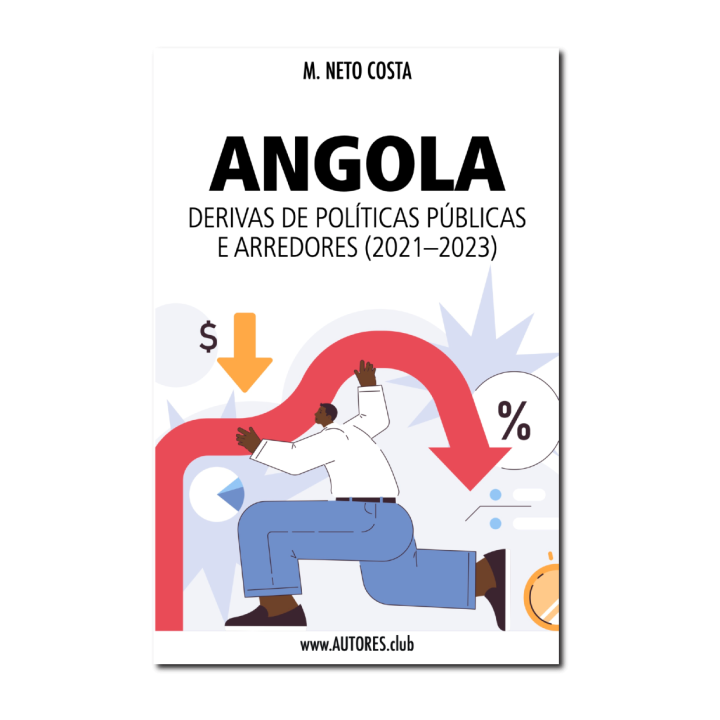
Angola: Public Policy Drifts and Surroundings (2021–2023) images
With analytical independence and deep knowledge of the machinery of the State, M. Neto Costa offers a structured reading of a decisive period in Angolan governance, covering the years from 2021 to 2023, marked by strong expectations of reform, persistent structural constraints and important political choices.
Author: M. Neto Costa
Publisher: Perfil Criativo – Edições
Year of publication: June 2026 — 1st edition
ISBN: 978-989-9209-40-4
Number of pages: 286
Language: Portuguese
Introduction
I. Global Economic Policy
1. The Resilience and Prospects of Decline of the American Empire
2. The BRICS Currency – An End to American Hegemony in the International Monetary System on the Horizon
II. Political Economy
3. Fighting Corruption – The Need for Measures to Scrutinise Companies’ Beneficial Owners
4. The Country’s Fundamental Problems and the Electoral Proposals of Political Parties and Coalitions – The Need to Advance Political Discourse and the Debate on Ideals Beyond Populism
5. Electoral Campaigns and ‘Armchair Coaches’
6. The Political Economy of Inefficient and Ineffective Enterprises in the Public Sector
7. Why Use Private Companies to Ensure the Security of Public Institutions’ Premises?
8. ‘Petrodollar Arrogance’ and National Public Finances – Is Our Swagger Gone?
9. Is This Angola?
III. The National Economy
10. Angola, 2021: The Winding Road to the Prosperity We Seek
11. Some Aspects of the Current State of Angola’s Economy
12. The Authorities, Public Service Provision and Informal Economic Activity
13. Chicken and Turkey Parts, Stalls in Kilamba’s Public Parks and Corruption Cases in the Higher Courts
IV. Public Policy
14. The Property Tax Code vs. the Constitution of the Republic of Angola – A Question of Tax Justice
15. The Electrification of the Country and Its Impact on Attracting Investment – Perspectives from the Sixth Edition of “Café CIPRA”
16. Population Dispersion – A Challenge to Efficient and Effective Public Service Provision and the Optimal Use of Associated Facilities
17. “Leaving No One Behind” – The Case of Education Services
18. A Look at the Socioeconomic Impact of Angola’s Hosting of International Sporting Events
19. The Civil Service Pay System – A Disincentive to Better Performance by Civil Servants and the Public Administration
20. At Least Administrative and Financial Deconcentration
21. Better Health Services? Enforce the Law!
22. Equity and Justice in Public Policy – A Social Inclusion Approach
23. Many Are Being Left Behind – Corruption and the Problem of Public Expenditure Priorities
V. Economic Policy and Macroeconomic Management
24. Questions Concerning Macroeconomic Policy to Stimulate Economic Activity
25. Unfair Charges on Businesses and Individuals – The Cases of Licensed Customs Brokers and Banks
26. A Case for State Intervention in Banking
27. Panic: A Consequence of Ignoring Risks in National Macroeconomic Management
28. Pricing Regimes: Some Order Is Needed
VI. Public Financial Management
29. Planning, Budgeting and Public Financial Management, Monitoring and Evaluation – Reflections on the “State of the Nation”
30. Rationalisation, Effectiveness and Efficiency of Public Expenditure – Reflections on the Proposed 2022 State Budget
31. The Need to Restructure the Public System of Financial Support for the Development of Economic Activities
32. The National Concessionaire’s Retention of the State’s Profit Oil – A Long-standing Oversight by the Tax Authority That Must Be Corrected
33. ‘Slush Funds’ – Evading the Problem or Making Matters Worse in the 2022 State Budget Law
VII. Monetary and Exchange Rate Policy
45. Aspects of Inflation Dynamics in Angola in Recent Years and the Cost of the Basic Food Basket
46. Further Reflections on Windfall Oil Revenue – Exchange Rate Policy Management
47. BNA – From the “Direct and Targeted Sale” of Foreign Currency to Directed Lending, or the ‘Sins’ of Notice No. 10/2022
48. The Conduct of Monetary and Exchange Rate Policies in the Face of Structural Problems in Angola’s Economy
VIII. The Private Sector and Investment
49. Aspects of Private Investment in the Diversification of the National Economy
50. Net Inflows of Capital and Foreign Investment into Angola – A Negligible Level Relative to the Country’s Needs
51. Insufficient Credit to the Private Sector for the Structural Transformation of Angola’s Economy
52. The Weakness of the Domestic Private Sector – An Obstacle to Economic Development and Diversification That Must Be Overcome
Afterword

 Security policy
 Delivery policy
 Return policy


Comments (0)
Your review appreciation cannot be sent
Report comment
Report sent
Your report cannot be sent