
- -30%

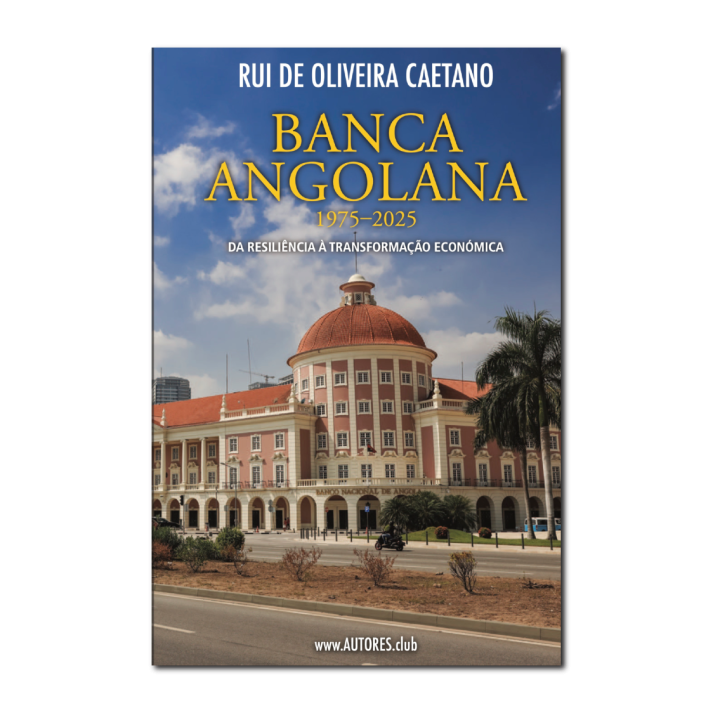
Angolan Banking, 1975–2025 — From Resilience to Economic Transformation images
From independence to the digital revolution, Angola’s banking sector has weathered wars, monetary reforms, oil crises and profound economic changes. It has endured, expanded and modernised. But to what extent has this transformation improved families’ lives and met businesses’ needs?
In Angolan Banking, 1975–2025 — From Resilience to Economic Transformation, Rui de Oliveira Caetano explores half a century of history to examine the achievements, vulnerabilities and choices that have shaped the national banking system. Combining documentary research with more than twenty-eight years of experience in the sector, the author guides readers from nationalisation to the opening up of banking to private enterprise, from post-war reconstruction to the challenges of digital payments, cybersecurity and artificial intelligence.
Author: Rui de Oliveira Caetano
Publisher: Perfil Criativo - Edições
First edition publication date: December 2026
ISBN: 978-989-9209-47-3
Number of pages: 224
Language: Portuguese
The history of Angolan banking is, to a large extent, intertwined with the country’s own economic and institutional development. Money, credit, deposits, payments and the ability to mobilise savings are more than merely technical matters. They are instruments of sovereignty, mechanisms for organising economic activity and essential elements of the relationship of trust between the State, institutions, businesses and citizens.
Between 1975 and 2025, Angola’s banking system underwent profound transformations. Beginning with a structure inherited from the colonial economy, it moved to a nationalised, centrally directed model, subsequently adopted a two-tier banking system, opened up to private enterprise, supported economic reconstruction following the end of the armed conflict and gradually incorporated new requirements for regulation, supervision, risk management and technological transformation.
This was not a linear journey. Banking evolved against a backdrop of war, high inflation, successive monetary reforms, dependence on oil revenues, periods of foreign exchange shortages, cycles of economic expansion and contraction, deteriorating credit quality and profound changes in the country’s productive and institutional structures. More recently, it faced the effects of the COVID-19 pandemic, the rapid growth of electronic payments, increasing digital fraud and the need to strengthen cybersecurity, data governance and operational resilience.
Understanding this trajectory therefore requires more than listing banks, legislation, monetary units or financial indicators. It requires connecting institutional changes to the economic conditions in which they occurred, understanding how external shocks were transmitted to the financial system and assessing the extent to which banking modernisation has translated into greater financial depth, effective inclusion and the capacity to finance the economy. (...)
From the Introduction.
Foreword by António Bingue
Introduction
Chapter 1 — From Colonial Banking to Independence
Chapter 2 — Nationalisation and Financial Centralisation, 1975–1990
Chapter 3 — Reform and the Transition to a Market Economy, 1991–2001
Chapter 4 — Peace, Reconstruction and Banking Expansion, 2002–2008
Chapter 5 — Consolidation, Imbalances and New Risks, 2009–2014
Chapter 6 — The Oil Shock and Adjustment, 2014–2019
Chapter 7 — Banking During the Pandemic and the Recovery, 2020–2022
Chapter 8 — Uneven Recovery, Profitability and Structural Challenges, 2023–2025
Chapter 9 — Financial Inclusion: Access, Usage and Quality
Chapter 10 — Payments, Digitalisation and New Service Models
Chapter 11 — Regulation, Supervision and Financial Stability
Chapter 12 — Credit, Impairments and Asset Quality
Chapter 13 — Profitability, Efficiency and Business Models
Chapter 14 — Financing the Angolan Economy
Chapter 15 — Cybersecurity, Data and Artificial Intelligence
Chapter 16 — Horizons for the Next Decade
Conclusion — From Resilience to Economic Transformation
Glossary of Terms and Acronyms
Bibliographical References

 Security policy
 Delivery policy
 Return policy


Comments (0)
Your review appreciation cannot be sent
Report comment
Report sent
Your report cannot be sent